

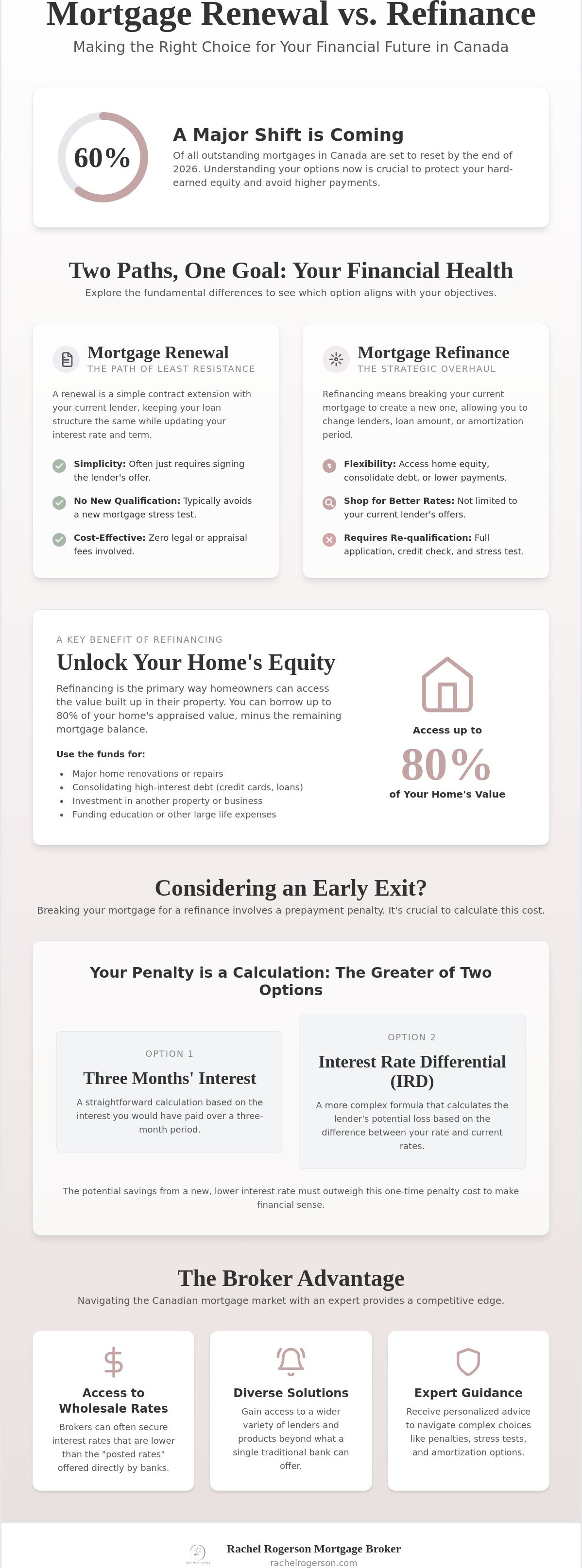
Did you know that approximately 60% of all outstanding mortgages in Canada are set to reset by the end of 2026? If you are among those homeowners, you're likely feeling the weight of shifting interest rate trends and the possibility of higher monthly payments. It's common to feel a bit trapped by your current bank's renewal letter, especially when you're worried about high prepayment penalties or missing out on a better deal elsewhere. Understanding the nuances of a mortgage renewal vs refinance Canada is the most effective way to protect your hard-earned equity.
We're here to help you discover the critical differences between these two paths so you can make the most cost-effective decision for your financial future. Whether you want to access cash for home renovations or simply find the lowest possible interest rate, this guide provides the clarity you need. We will break down the costs of breaking a contract, explain how new OSFI regulations might impact your choice, and show you how to restructure your debt to improve your overall financial health.
Key Takeaways
- Learn the fundamental differences between a mortgage renewal vs refinance Canada to determine which financial path maximizes your long-term savings.
- Understand how to bypass the mortgage stress test by renewing with your current lender when you're satisfied with your existing terms.
- Evaluate the true cost of breaking your mortgage early by comparing three-month interest penalties against the Interest Rate Differential (IRD).
- Discover how strategic refinancing allows you to unlock up to 80% of your home's equity for major goals like renovations or debt consolidation.
- See how a mortgage broker provides a competitive edge by accessing wholesale rates and diverse solutions that traditional banks often cannot offer.
Understanding the Core Differences: Renewal vs. Refinance
A mortgage renewal is essentially a contract extension. When your current term ends, your lender offers a new interest rate for a new term, but the underlying loan structure remains untouched. Refinancing is a different animal entirely. It involves breaking your existing contract to create a new one, often with a different lender, a different balance, or a different amortization period. While a renewal is often as simple as signing a letter from your bank, a refinance requires a full application, including a credit check and income verification. Deciding between a mortgage renewal vs refinance Canada requires a clear look at your long-term goals.
Renewals are the path of least resistance. They typically involve zero legal or appraisal fees because you aren't changing the registered charge on your property. Refinancing, however, requires a lawyer to discharge the old mortgage and register the new one. You will also likely need a fresh appraisal to confirm your home's current market value. These costs can range from C$1,000 to C$2,500, so the benefit must outweigh the expense. If you stay with the same bank for a renewal, you might even avoid a fresh stress test, which is a major win if your income situation has changed. Choosing a mortgage renewal vs refinance Canada depends on whether you value simplicity or flexibility.
The Legal and Financial Mechanics
Refinancing gives you the power to restructure your debt. You can increase your loan amount to access equity or change your amortization to lower payments. In contrast, a renewal only updates the interest rate and term length; your principal balance stays exactly where it is. If you want a better rate but don't need extra cash, you might consider "switching" or "transferring" your mortgage to a new lender. This hybrid approach often allows you to move your existing balance to a new institution at renewal time without the full legal costs of a refinance. Understanding Refinancing helps clarify why this complete replacement of terms is a strategic move for many homeowners.
When the Clock Starts: Amortization Impacts
Many homeowners fear that a refinance resets their 25 year journey back to day one. This is a common misconception. You have the choice to maintain your original "burn-down" schedule. If you have 17 years left on your mortgage, you can set your new refinance to a 17 year amortization. However, if your goal is to improve monthly cash flow, you can choose to extend the amortization. A 30 year amortization period has been introduced for certain borrowers, offering significant relief for monthly budgets. This lowers your monthly obligation but increases the total interest you will pay over the life of the loan. It is a trade-off between today's breathing room and tomorrow's equity growth.
The Path of Least Resistance: When a Mortgage Renewal is Best
For many Canadians, the path of least resistance is simply to renew. If you've been happy with your current bank and your financial situation hasn't changed significantly, a renewal is the most straightforward route. One of the biggest advantages of staying with your existing institution is that you typically don't have to undergo a new mortgage stress test. This is a massive benefit if you're self-employed or if your debt-to-income ratio has shifted since you first signed your original documents. When weighing a mortgage renewal vs refinance Canada, this lack of re-qualification can be the deciding factor for those who want to avoid the paperwork of a full application.
However, simplicity shouldn't lead to complacency. Many homeowners fall into the "auto-renewal" trap. If you don't respond to your bank's renewal letter, they may automatically roll you into a new term at their "posted rate," which is often significantly higher than the best rates available. According to TD Canada Trust on mortgage renewal vs. refinancing, taking a proactive approach allows you to negotiate better terms before your current contract expires. You should never accept the first offer without checking what the rest of the market provides.
The 120-Day Strategy
The 120-day window is your most powerful tool. Most Canadian lenders allow you to lock in a renewal rate up to four months before your current term ends. This "rate hold" protects you if interest rates climb before your renewal date. If rates happen to drop during that period, most lenders will honour the lower rate. It's a win-win scenario that provides peace of mind in a volatile market. To get started, use a mortgage calculator to see how different rates might impact your future monthly budget and long-term interest costs.
Switching Lenders at Renewal
Don't confuse switching lenders with a full refinance. Moving your existing mortgage balance to a new institution at the end of your term is known as a "transfer" or "switch." Unlike a refinance, where you break the contract early and pay a penalty, a transfer at the end of your term is usually penalty-free. Many competing lenders are so eager for your business that they will cover the appraisal and legal fees associated with the move. You will still need to provide proof of income and go through a stress test with the new lender, but the savings on your interest rate can make the extra effort well worth it.
Strategic Refinancing: Unlocking Home Equity and Better Terms
While a renewal keeps your current financial structure intact, strategic refinancing allows you to pivot toward better long-term outcomes. The primary triggers for this move are often a desire for lower interest rates or a need for significant capital. For instance, if you are currently locked into a rate above 5% and the best 5-year fixed mortgage rate is sitting at 4.09% as of July 2026, the interest savings could be substantial. In Canada, you can typically refinance up to the 80% Loan-to-Value (LTV) rule, meaning you can borrow against 80% of your home's appraised value. This creates a powerful opportunity to access cash for life transitions like marriage, divorce, or preparing for a comfortable retirement. When choosing between a mortgage renewal vs refinance Canada, consider if your current loan still aligns with your life's next chapter.
Refinancing is also the ideal time to add a Home Equity Line of Credit (HELOC) to your financial toolkit. A HELOC provides a revolving credit limit that you can tap into as needed, only paying interest on the amount you actually use. This setup offers far more flexibility than a standard mortgage, especially for homeowners who want a safety net for unexpected repairs or investment opportunities. It turns your home equity into a dynamic asset rather than a static number on a statement.
Debt Consolidation via Refinance
One of the most effective uses of a refinance is consolidating high-interest debt. Many Canadians carry credit card balances with interest rates of 19% or higher. By rolling that debt into a new mortgage at a rate closer to 4.09%, you can drastically reduce your monthly interest costs and improve your overall cash flow. This move can save you hundreds of dollars every month, giving your budget much-needed breathing room. However, discipline is essential. You must avoid the temptation of "re-loading" those credit cards after the consolidation is complete, or you risk falling back into the same debt cycle with a higher mortgage balance.
Financing Renovations and Property Improvements
Refinancing is frequently a more cost-effective way to fund home improvements compared to a personal loan or high-interest line of credit. Because the loan is secured by your property, the rates are significantly lower, and the repayment can be spread over a longer amortization period. These improvements don't just make your home more livable; they often increase your property value, which can improve your LTV ratio during your next renewal. To maximize this strategy, some homeowners use an Appraisal Bridge. An Appraisal Bridge is a valuation process where a lender determines the future market value of your home based on the projected completion of specific, documented renovations.
Breaking Your Mortgage: Calculating the Prepayment Penalty
The most common objection to restructuring a loan is the fear that the penalty will be too high. It is a valid concern, but you shouldn't let a one-time cost blind you to long-term savings. When evaluating a mortgage renewal vs refinance Canada, understanding how your lender calculates your exit fee is essential. If you have a variable-rate mortgage, the math is usually straightforward: you will pay three months of interest. However, if you have a fixed-rate mortgage, your penalty is the greater of three months of interest or the Interest Rate Differential (IRD).
The IRD is where many homeowners feel trapped by their current bank. This calculation compares your original interest rate to the current market rate for the time remaining on your term. To estimate your IRD penalty, use this simple formula: (Your Current Rate - Today's Rate for your remaining term) x (Your Balance) x (Months Remaining / 12). Because fixed-rate penalties are designed to compensate the bank for the interest they lose when you leave, these costs can climb significantly if rates have dropped since you first signed. Variable-rate penalties remain much more predictable, making them a favourite for those who value flexibility.
The "Break-Even" Analysis
A penalty of C$10,000 might sound intimidating, but it's only one side of the ledger. You must perform a break-even analysis to see if the move makes sense. For example, if refinancing to a lower rate saves you C$400 every month in interest, you will recover a C$10,000 penalty in 25 months. If you have three or four years left on your term, you could end up saving over C$20,000 in total interest even after paying the penalty. Many lenders allow you to "roll the penalty" into your new mortgage balance, which means you don't need to have the cash on hand to make the switch. To see how these numbers work for your specific situation, explore our mortgage calculators to run your own comparison.
The Hidden Costs of Refinancing
Beyond the prepayment penalty, you should budget for several administrative costs. Because a refinance involves creating a brand-new legal charge on your property, you will encounter discharge fees from your old lender and registration fees for the new one. Legal costs typically range from C$1,000 to C$1,500 to handle the title search and documentation. Additionally, an appraisal is almost always required to confirm your home's value, which usually costs between C$300 and C$500. While these fees add up, a proactive broker can often negotiate with a new lender to have some of these costs covered as an incentive for moving your business.
The Broker Advantage: Navigating the Canadian Mortgage Market
Choosing between a mortgage renewal vs refinance Canada doesn't have to be a solo mission. While your local bank branch is limited to its own proprietary products, a mortgage broker acts as your personal shopper in the wholesale market. This access is a game-changer. It means instead of one set of rates, you get access to dozens of lenders simultaneously. This includes major banks, credit unions, and monoline lenders that only work through the broker channel, often providing lower rates because they don't have the overhead costs of physical branches.
Think of it as a concierge service for your largest debt. A bank representative is an employee of the institution; their goal is to sell you that specific bank's mortgage. A broker works for you. They manage the heavy lifting of lender negotiations and paperwork, ensuring you aren't just getting "a" rate, but the "right" rate for your specific equity goals. Best of all? In the vast majority of standard residential cases, the broker is paid a finder's fee by the lender, not by you. You get specialized expertise and a multi-solution approach without an added bill. This allows you to compare the true cost of a mortgage renewal vs refinance Canada across the entire market rather than just one institution's menu.
Accessing Niche Lenders and Private Options
Not every homeowner fits the "Big Five" bank box. If you're a self-employed Canadian or have a non-traditional credit profile, the strict criteria of major institutions can feel like a brick wall. This is where Independent Broker Benefits truly shine. Brokers have established relationships with B-Lenders and private mortgage providers who specialize in these scenarios. They understand how to package your application to highlight your financial strengths, finding solutions that protect your home equity even when traditional lenders hesitate. Whether you need a private mortgage for a short-term bridge or a B-Lender to accommodate fluctuating income, a broker finds the path forward.
Your Next Steps: From Pre-qualification to Closing
Ready to move forward? The process is designed to be as streamlined as possible, respecting your time and peace of mind. It starts with a 60-second online pre-qualification. This quick check gives you an immediate sense of your borrowing power without the pressure of a formal bank meeting. Once you're ready to lock in a deal, you'll need a few key documents to ensure a smooth closing:
- Income Verification: Recent pay stubs or two years of Notices of Assessment (NOAs) for the self-employed.
- Property Documents: Your current mortgage statement and most recent property tax bill.
- Insurance & ID: Confirmation of homeowners insurance and valid government-issued identification.
Don't leave your financial future to chance or an automated renewal letter. Pre-qualify for your renewal or refinance today and take control of your mortgage journey with a partner who puts your interests first.
Secure Your Financial Future Today
Deciding between a mortgage renewal vs refinance Canada often comes down to your immediate cash flow needs and long-term equity goals. You now understand that while a renewal offers simplicity, a strategic refinance can unlock capital for renovations or consolidate high-interest debt into a single, affordable payment. Calculating your break-even point on prepayment penalties is the final step in ensuring your decision is truly cost-effective for your household budget.
Partnering with a licensed expert who serves clients across Canada gives you a distinct advantage in this volatile market. We provide access to over 50 institutional and private lenders, specializing in complex scenarios ranging from reverse mortgages to sophisticated debt consolidation strategies. This modern approach ensures you aren't just signing a bank letter; you are actively optimizing your wealth. Our team acts as your dedicated partner to navigate every regulation and interest rate shift with ease.
Get a personalized mortgage renewal or refinance quote in 60 seconds.
You deserve a mortgage that works as hard as you do. Take the first step toward a smarter financial future and gain the peace of mind you've been looking for today.
Frequently Asked Questions
Is it better to renew or refinance my mortgage in Canada?
Choosing between a mortgage renewal vs refinance Canada depends on your need for flexibility and your current financial goals. A renewal is a simple extension of your current contract with your existing lender, keeping your principal balance the same. In contrast, a refinance involves breaking your mortgage to start a new one, which allows you to access equity or change your loan structure. If your goal is to minimize paperwork and keep your current terms, a renewal is likely the better choice.
How much does it cost to refinance a mortgage in Canada?
Refinancing involves several administrative and legal expenses that you should factor into your decision. You should prepare for appraisal fees to determine your home's current value, legal fees for title registration, and discharge fees from your old lender. If you break your term early, you will also face prepayment penalties. These are usually calculated as three months of interest or the Interest Rate Differential. Many homeowners choose to roll these costs into their new mortgage balance.
Can I switch lenders at mortgage renewal without a penalty?
You can switch lenders at the end of your term without facing a prepayment penalty. This process is often called a mortgage transfer or switch. Many lenders offer incentives to new clients, such as covering the appraisal and legal costs associated with the move. It is an excellent opportunity to shop the market for lower interest rates while avoiding the high costs associated with a full mid-term refinance.
What is the maximum I can borrow when refinancing my home?
The maximum amount you can borrow is 80% of your home's appraised value. This 80% Loan-to-Value limit is a standard federal regulation for refinances in Canada. If you have significant equity, this allows you to pull out cash for investments, renovations, or other major life expenses. You must leave at least 20% equity in the property to satisfy the requirements of most traditional lenders.
Will my amortization period reset if I refinance my mortgage?
Your amortization does not automatically reset when you refinance your property. You have the option to keep your current timeline to stay on track for your original mortgage-free date. However, some homeowners choose to extend their amortization back to 25 or 30 years. This move lowers your monthly payments and provides more breathing room in your budget, though it increases the total interest paid over the life of the loan.
Can I refinance my mortgage to pay off high-interest credit card debt?
Refinancing your mortgage to consolidate high-interest debt is a highly effective financial strategy. By moving credit card balances with rates of 19% or higher into a mortgage with a much lower rate, you reduce your interest costs significantly. This consolidation simplifies your finances into one monthly payment. It also improves your overall cash flow, allowing you to pay down the principal balance of your debt much faster than before.
How long does the mortgage refinancing process take?
A typical mortgage refinance takes between two and four weeks to process from start to finish. The timeline depends on how quickly an appraiser can visit your home and how fast the legal documentation is prepared. Providing your income tax papers and current mortgage statements upfront can speed up the process. Working with an efficient broker ensures that every step, from the initial application to the final closing, moves as quickly as possible.
Do I need to pass the stress test again when I renew my mortgage?
You do not need to pass the stress test if you renew your mortgage with your current bank. However, if you want to explore the mortgage renewal vs refinance Canada debate by switching lenders, you must qualify under current stress test rules. This requirement also applies to any refinance application. Staying with your existing lender is often the easiest path if your financial situation makes re-qualification a challenge.